
Introduction to EXPRESS
Textual with graphical modelling
EXPRESS is a language family for representing an information model.
EXPRESS started as a single lexical language but has since expanded into a family of languages, including EXPRESS-G, its graphical language.
EXPRESS has the following attributes:
-
Computer processable.
-
Provides a superset of NIAM and IDEF1X representation capabilities.
-
Exhibits an object oriented flavor.
-
Has several aspects (subsets)
It was developed by a small group (about 4 at any given time) for modeling the kinds of information used in engineering. CAD models, blueprints, mechanisms, engineering sign-off, and so on.
There were releases every quarter to a user group of about 50, who were full of their own suggestions and merrily changed the language in between times.
In the first years there were no compilers (the language was changing too rapidly) so there were no technical constraints — every use of the language was perfect, no bugs, no complaints!
One of the strengths of EXPRESS is that it much of it was developed by the end users.
|
Note
|
The end user focus is also probably its major weakness as its initial coherence sank under the weight. |
Aspects of EXPRESS
-
Implementation independent. EXPRESS supports the modeling of things and relationships in an implementation independent manner.
The principal elements of EXPRESS are for representing things and the relationships between things (and as far as EXPRESS is concerned, a relationship is a thing). Groups of strongly related things can be collected together.
-
Algorithms for arbitrary constraint specifications. EXPRESS includes a Pascal-like programming language for specifying complex constraints.
-
Modeling of implementation dependent data structures. EXPRESS is a conceptual modeling language, so puts no restrictions on the number of characters in a name, and arithmetic is infinitely precise.
-
Graphical form. EXPRESS-G is the graphical form of EXPRESS, which is a subset of the lexical language.
-
Instantiation format. EXPRESS-I is a lexical language for displaying data (instances) that correspond to the concepts in EXPRESS.
-
Transformation form. EXPRESS-X is a lexical language that allows specification of desired changes to an EXPRESS model and then have them performed. Transformations principally consist of splitting or merging things and their relationships.
Usage
EXPRESS is widely used in the standards community for formal definition of data-related concepts.
Some use cases include:
-
Definition of the STEP models (hundreds of people from 20+ countries)
-
Reverse engineering of DBMS systems
-
Software Specification Document for CAD geometry processors
-
Electronic standards (VHDL, EDIF, CFI etc)
-
European ESPRIT projects
-
Data Definition Language for OO databases
-
Geological modeling
-
Genome modeling
In fact, EXPRESS can also be used to define the syntax, grammar, and semantics of the EXPRESS language.
Introduction to STEP
History
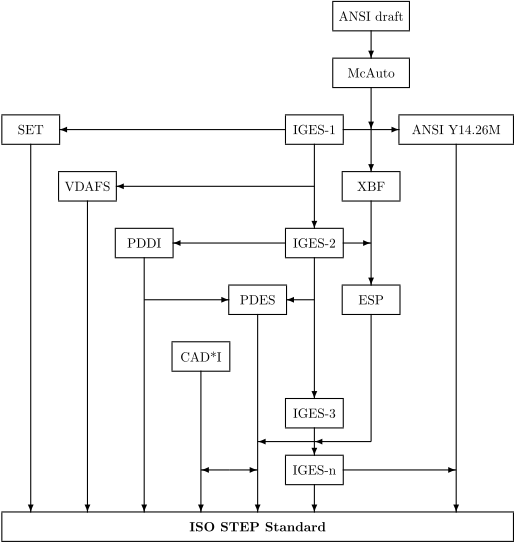
The story of STEP starts in the mid 1970’s with a small group trying to develop an ANSI standard for geometry data.
At the end of the 70’s McAuto (part of McDonnell Douglas) got a contract from CAM-I (Computer Aided Manufacturing — International) to develop a standard for data exchange between solid modeling systems; the result was not well received.
Just after this, Boeing (Walt Braithwaite), GE (Phil Kennicott) and the then National Bureau of Standards (Roger Nagel) produced IGES — Initial Graphics Exchange Specification for data exchange between CAD (Computer Aided Drawing) systems. This was reluctantly implemented by the major CAD vendors and rapidly became the ANSI Y14.6M standard (the last section of which was the McAuto work). Then came a proliferation of standards.
As IGES was not written in France, the French published their "SET" standard. CAM-I still wanted a solid model data exchange mechanism and came up with the XBF ("Experimental Boundary File"), an extension of IGES, which itself was going through several expansions. The Germans produced VDAFS specifically for sculptured surfaces as used for car bodies. The XBF work moved under the IGES umbrella and became ESP (Experimental Solids Proposal).
The USAF gave McDonnell Douglas a 2 part contract to:
-
(a) for a small amount of money, determine if IGES met USAF (and industry) requirements and if it did not;
-
(b) for a large amount of money, develop something that did.
Unsurprisingly, they determined that IGES was unsuitable and so came up with the PDDI standard. There was also yet another effort going on in Europe called the CAD*I project funded under the ESPRIT program.
IGES was experiencing growing pains and it seemed sensible to make a fresh start. Boeing (Kal Brauner and Dave Briggs) proposed PDES — Product Data Exchange Standard based on the best work from the US. In particular, they strongly urged that it should have a formal basis.
Somehow the international community got together and demanded just one standard — STEP, Standard for the Exchange of Product Model Data, to be based on the technical work from the PDES group.
After a while some countries got upset as they felt that it had become a US standard (even though most participants were non-US). This dilemma was eventually resolved by changing the name of PDES to be — "Product Data Exchange using STEP" (which some then called Standard for Exchange using PDES).
STEP standards
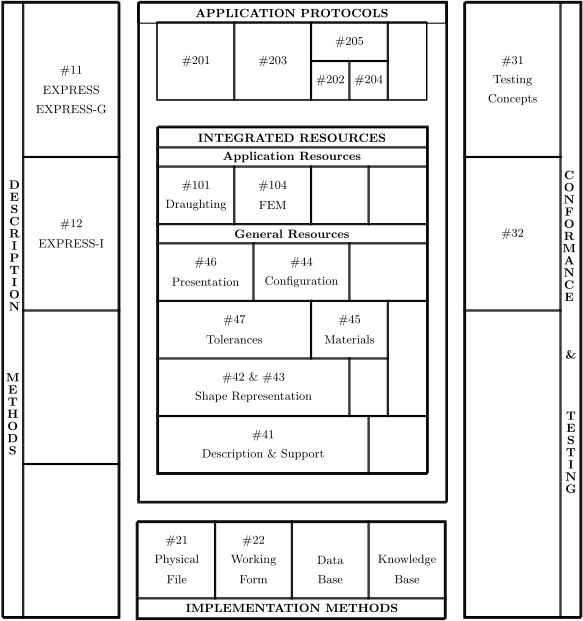
The STEP standard, ISO 10303, is really a suite of cooperating standards each member of which is a Part of ISO 10303.
The Parts are grouped into series.
-
Parts 11-19 form the Description Methods series, which include the EXPRESS family.
-
Parts 21-29 form the Implemantation Methods series, defining how to exchange data that corresponds to an EXPRESS model.
-
Parts 31-39 form the Conformance and Testing series, defining how to test STEP implementations.
-
Parts 41-99 form the Resources series, which define an integrated set of application independent EXPRESS information models for product descriptions.
-
Parts 201+ form the Application Protocol (AP) series, which specify application dependent information models for the purposes of data exchange.
STEP architecture
General
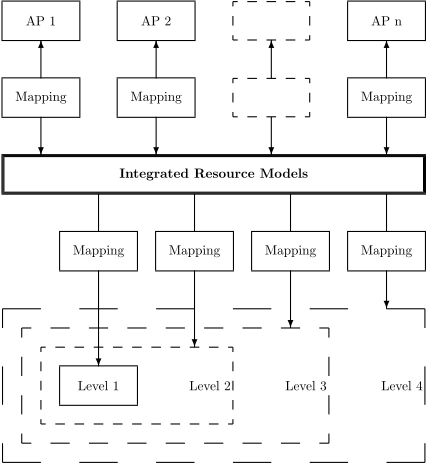
The STEP architecture is centered around the Integrated Resource Models (IRs), which are defined using EXPRESS.
An Application Protocol (AP) is a subset of the IRs. It includes an EXPRESS model mapped from the EXPRESS models in the IRs.
The implementation methods, called Level 1, Level 2, and so on, are exchange mechanisms for data that corresponds to an EXPRESS model. They essentially consist of a mapping from EXPRESS to a data representation.
As far as a typical end user is concerned, the IRs are invisible and there are APs and exchange levels.
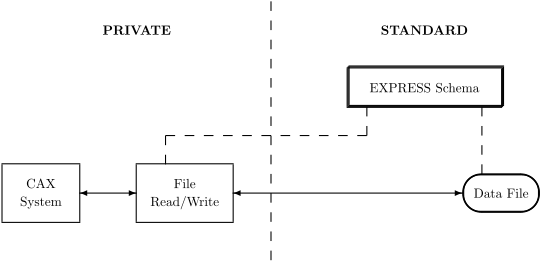
Level 1 exchange
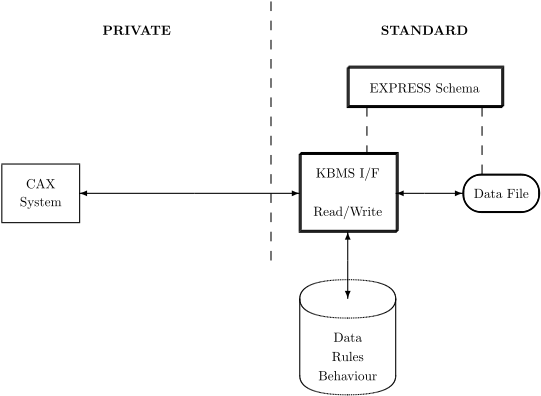
Level 1 data exchange is file-based. Get your CAD system to create a STEP data file then archive it and/or send it to someone else (to read into their CAD system).
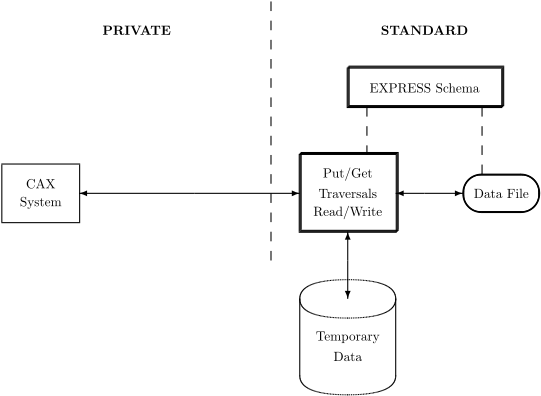
Level 2 exchange
Level 2 data exchange is memory-based. Get your CAD system to create a (temporary) STEP database which you can then query and change. The data can be written to a file for Level 1 use. At the end of the session the STEP database is no longer available.
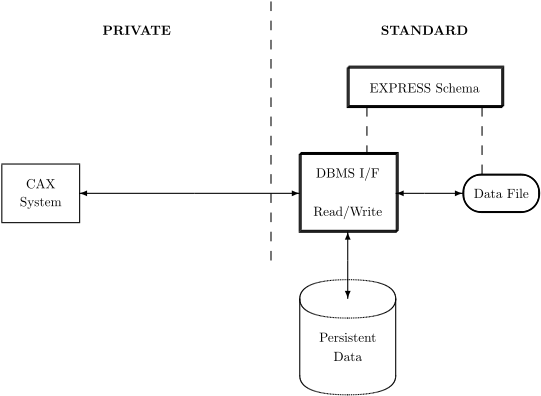
Level 3 exchange
Level 3 data exchange is database-based. The STEP data is maintained in a (permanent) shared database. STEP level 1 files can be written and read by the database.
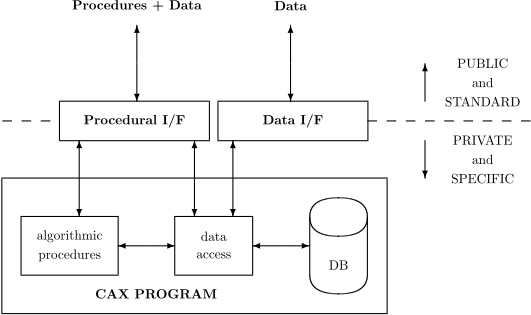
Procedural exchange
This allows not only data, but also commands (and their results) to be passed into and out of a CAX program in a standardised manner.
For example, instead of inserting the data representing, say, a block with a hole in it, tell the system to create a block, put a hole in it, and then perhaps move it to another position. The end result in terms of data values can be the same but the route is very different.
Level 4 Exchange
This was the vision when STEP started — intelligent knowledgebases as an exchange mechanism.
The vision has faded.
The majority of STEP implementations are Level 1 (file exchange). Internally, though, they are implemented using a Level 2 or 3 architecture.